
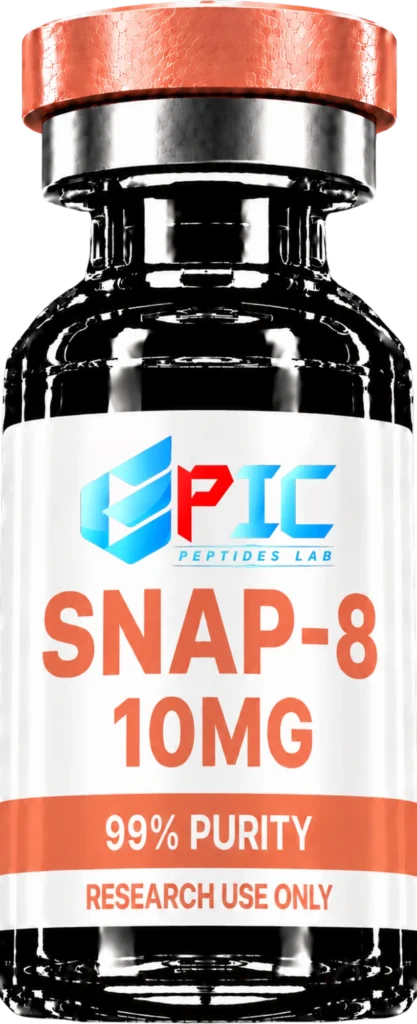
SNAP-8 has two names because it lives in two worlds. The cosmetic industry that created it calls it acetyl octapeptide-3 and formulates it at fractions of a percent. This catalogue sells it as 10mg of powder. Laboratory research use only.
Epic Peptides Lab · Research Use Only
A cosmetic ingredient with a second name and a second life
SNAP-8 comes from the cosmetic industry rather than from pharmaceutical research, and that shows up in three places: it has a second name assigned by a naming system most researchers have never used, it is normally supplied dissolved rather than dry, and the quantity here is large relative to how it is actually used.
| Property | Value |
|---|---|
| Common designation | SNAP-8 |
| INCI name | Acetyl octapeptide-3 |
| What INCI is | The naming system used for cosmetic ingredient labelling |
| Residue count | 8 |
| Amino terminus | Acetylated |
| Carboxy terminus | Amidated |
| Molecular weight, calculated | Approximately 1,075.2 g/mol |
| CAS | 868844-74-0 |
| Relationship to acetyl hexapeptide-8 | An extended version of that shorter and better known sequence |
| Methionine present | Yes, one. It oxidises, adding sixteen daltons |
| Usual commercial form | An aqueous solution at low percentage, supplied to formulators |
| Form supplied here | Lyophilized powder at a nominal 10 mg |
| Typical use level in a finished formulation | Fractions of one percent |
| Regulatory status | A cosmetic ingredient. No approved pharmaceutical formulation |
| Storage, lyophilized | 2-8°C short term, -20°C for extended storage, protected from light and moisture |
The two names for snap-8 come from different naming systems that do not talk to each other, and knowing which is which resolves most of the confusion.
Acetyl octapeptide-3 is an INCI name. That system exists to label cosmetic ingredients consistently across markets, and every ingredient in a cosmetic formulation carries one.
INCI names for peptides are descriptive and sequential rather than structural. Acetyl octapeptide-3 says the molecule is an acetylated eight-residue peptide and that it was the third such entry registered.
It does not encode the sequence. Two entirely different octapeptides would receive adjacent numbers and nothing in the name would distinguish them chemically.
SNAP-8 is a trade designation used by the supplier who developed and marketed it, and it carries no more structural information than the INCI name does.
Neither name tells a researcher what is in the vial. The sequence does, and it should be printed on the certificate.
That matters more here than for a compound with a single research designation, because a buyer searching either name will find suppliers using the other, and matching them requires the sequence rather than the label.
It also explains a persistent confusion with the shorter and better known relative in the same family, which carries a different INCI number and a different sequence entirely.
The two are related by design and are not interchangeable, and neither name does anything to stop them being confused.
Snap-8 was developed for formulation rather than for the laboratory, and it arrives with different assumptions built into it.
The first is the form. Ingredients of this kind are normally supplied to formulators as dilute aqueous solutions, often at a few percent, ready to be blended into a product.
That is convenient for a factory and useless for a laboratory, which is why a research presentation exists as powder instead.
The powder is therefore the unusual form rather than the standard one, and it is worth confirming that what arrives is the peptide rather than a dried-down solution carrying its original excipients.
The second assumption is concentration. Formulation use levels sit at fractions of a percent, which on a topical product means a very small absolute quantity spread across a large volume.
Ten milligrams of powder is therefore a large amount relative to how the compound is normally handled, and it is a small amount by the standards of a research vial.
The third is the evidence base. Cosmetic ingredient literature is published to different conventions from pharmacological literature, frequently in industry journals, and often reports formulation-level outcomes rather than mechanistic ones.
That is not a criticism of the work and it does mean the endpoints differ. A study measuring a formulation outcome and one measuring a molecular interaction answer different questions.
Anyone bringing this compound into a mechanistic experiment is doing something the original literature largely did not, which is worth knowing before designing around published figures.
A snap-8 certificate carries six fields, and the first two exist because of the naming problem.
The sequence written out in full, since neither the trade designation nor the INCI name encodes it.
Both names stated together, which lets a buyer match a certificate against a listing found under the other one.
Observed mass against calculated mass, with the calculated figure stated. Approximately 1,075 is the acetylated and amidated octapeptide.
Confirmation of both terminal modifications. The acetyl group and the carboxy-terminal amide are each part of the definition and each is a routine synthesis omission.
Whether any oxidised species was detected, because the sequence carries a methionine and it behaves the same way methionine does anywhere else.
Counterion identity alongside net peptide content, together with the lot number and the synthesis date.
A certificate stating the INCI name alongside the trade designation is doing something almost no research supplier bothers with, and it is the field that makes the article identifiable across both markets.
The mechanistic account attaches to the family rather than to snap-8 specifically, which is worth stating clearly.
The shorter relative in this family was described in the early 2000s as interfering with a protein complex involved in vesicle fusion, and the peptide was designed as a fragment mimicking part of that complex.
The proposal was that occupying a position in the assembly would interfere with the complex assembling properly.
That work was done on the shorter sequence. This compound is an extended version of it, developed later and marketed on the same rationale.
Whether the extension changes the interaction, improves it, or does nothing to it is a question the published record addresses far less thoroughly than the marketing does.
So the honest position is that a mechanism is proposed for the family, demonstrated primarily for one member, and extended to this one by analogy.
That is a common situation in this catalogue and it is unusually easy to see here, because the two compounds are sold side by side with the same story attached to both.
The useful move is to read the work on the shorter sequence directly, and to require independent evidence for any claim made about this one.
The blog covers the complex and the proposed mechanism in more depth than a product page should.
The quantity of snap-8 in this vial is worth putting next to how the compound is normally used, because the two figures are further apart than they look.
A finished cosmetic formulation carries this ingredient at fractions of one percent, and the ingredient itself is usually supplied to the formulator already dissolved at a low percentage.
So the working quantity in that industry is a small fraction of a small fraction, spread through a large volume of base.
Ten milligrams of dry powder is a considerable amount against that, and it is a modest amount against a research vial of a synthetic peptide.
That mismatch has a practical consequence when reading published use levels across the two worlds.
A formulation percentage cannot be converted into a laboratory concentration without knowing the density and the volume it sat in, and those are rarely stated.
Mechanistic work uses molar terms instead. The two vocabularies do not translate cleanly in either direction.
Anyone bringing a formulation figure into a molar calculation is making assumptions that should be written down rather than left implicit.
The safer approach is to work from published molar concentrations where mechanistic studies exist, and to read formulation percentages as describing a different question.
For this compound the mechanistic literature is thinner than the formulation literature, which is the shape the whole page has been describing.
Handling snap-8 is conventional for a short peptide with one reactive residue.
Sealed dry powder holds at refrigeration temperature briefly and at minus 20 for longer, with light and moisture both excluded.
The methionine is the one chemical liability. It oxidises under ordinary conditions, adding sixteen daltons and producing a more polar species that elutes earlier on a reverse-phase gradient.
On a 1,075 dalton molecule that is roughly one and a half percent, which a high-resolution instrument resolves and a nominal-resolution one can miss.
Keeping solutions cold, dark and briefly held is the practical answer, as it is for any methionine-containing peptide.
Bring the vial to ambient temperature before opening, since the powder is hygroscopic.
The sequence carries two arginines and two glutamates, so it is amphoteric rather than strongly charged either way, and it dissolves readily in aqueous buffer.
Aliquot on first reconstitution and use low-binding consumables at working dilutions.
Record lot, both names as they appear on the certificate, net peptide content, diluent and date. Recording both names makes the material traceable across the two markets it exists in.
A closing note on sourcing rather than on handling.
The same compound is available through cosmetic ingredient suppliers and through research chemical suppliers, at different purities and in different forms.
Neither market is inherently better and they answer to different standards, so knowing which one a lot came from is worth a line in the record.
A closing observation about where the useful information on this compound actually lives.
Peptide catalogues describe snap-8 briefly and repeat one another.
The primary work sits in cosmetic science journals and in the SNARE literature that predates the cosmetic application by years.
Those two bodies of writing use different vocabulary for the same protein complex, so a search phrased in one will miss the other entirely.
Anyone building a reference list should search under snap 8 peptide and again under SNAP-25 and SNARE.
The cosmetic literature is thin and the mechanistic literature is not.
The gap between the two is where most of the confusion about this material starts.
Selected references on the peptide family, on the complex it was designed against and on cosmetic peptide ingredients generally.
What is SNAP-8?
An acetylated and amidated eight-residue peptide, calculated at approximately 1,075 daltons, carrying CAS 868844-74-0 and the INCI name acetyl octapeptide-3.
What is an INCI name?
A designation from the naming system used to label cosmetic ingredients consistently across markets. Every ingredient in a cosmetic formulation carries one.
Does the INCI name encode the sequence?
No. It says the molecule is an acetylated eight-residue peptide and that it was the third such entry registered. Two entirely different octapeptides would receive adjacent numbers.
Why does the double naming matter?
Because a buyer searching one name will find suppliers using the other, and matching them requires the sequence rather than the label. The sequence should be on the certificate.
What form is it normally supplied in?
To formulators, as a dilute aqueous solution at a few percent, ready to blend into a product. The powder sold as a research article is the unusual form, not the standard one.
What should be confirmed about the powder then?
That it is the peptide rather than a dried-down solution carrying the excipients of its original commercial form.
How is it normally used?
At fractions of one percent in a finished formulation, which is a very small absolute quantity spread across a large volume. Ten milligrams is large relative to that.
Is the literature the same as pharmacological literature?
Not entirely. Cosmetic ingredient work is published to different conventions, often in industry journals, and frequently reports formulation-level outcomes rather than mechanistic ones.
What is the proposed mechanism?
Interference with a protein complex involved in vesicle fusion, by a peptide designed to mimic part of that complex and occupy a position in the assembly.
Was that demonstrated for this compound?
Primarily for a shorter relative in the same family. This one is an extended version marketed on the same rationale, and whether the extension changes the interaction is addressed far less thoroughly.
What is the chemical liability?
The methionine. It oxidises under ordinary conditions, adding sixteen daltons and producing a more polar species that elutes earlier on a reverse-phase gradient.
How large is that on this molecule?
Roughly one and a half percent on 1,075 daltons, which a high-resolution instrument resolves and a nominal-resolution one can miss.
SNAP-8 is sold exclusively for laboratory research use. It is not a drug, food, or cosmetic product, and it is not a dietary product of any kind. It is not approved by the FDA or any comparable authority for human or veterinary use, it is a cosmetic ingredient rather than a pharmaceutical compound and its published record largely reports formulation-level outcomes rather than mechanistic ones, the proposed mechanism was demonstrated primarily for a shorter relative in the same family and extended to this compound by analogy, and no compound in this range is offered for any human or veterinary purpose. This product is not intended to diagnose, treat, cure, or prevent any disease. It must not be given to humans or animals. Purchase is restricted to qualified researchers and institutions operating within applicable laws. All handling is the responsibility of the purchasing laboratory.
The same verification the labs that use our compounds demand — documented, transparent, and enforced on every order.

Independent HPLC and mass-spec testing confirms identity and purity on every batch.

A full certificate of analysis is published and downloadable for every lot we ship.

Tracked, discreet packaging with reshipment coverage on qualifying orders.

Orders confirmed before 12 PM PT on business days ship the same day from our US-based facility.
Enter your details to access our catalog, COA library,
and research compound database.
By submitting you agree to receive email communications from Epic Peptides Lab You can unsubscribe at any time. All products for in vitro research use only.

Restock alerts, new compounds and fresh lab results.
We’ll email your code straight away – 15% off, one-time use.
Research updates only. Unsubscribe any time.
Reviews
There are no reviews yet.