
$29.99
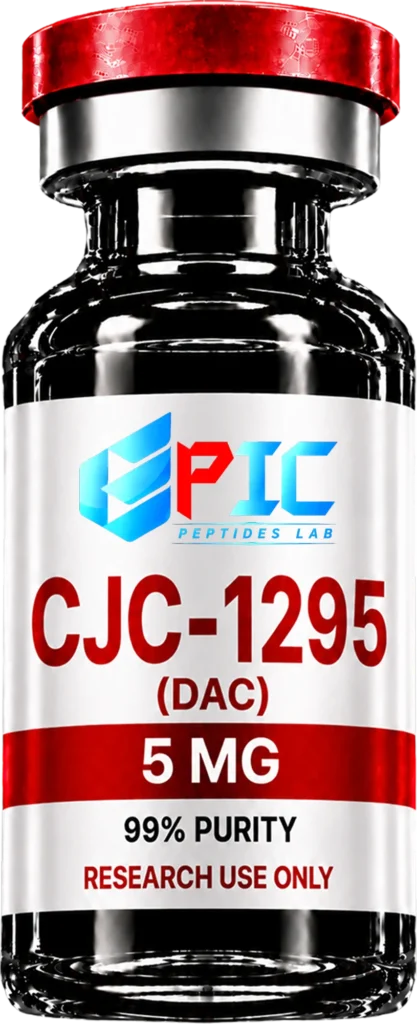
CJC-1295 no DAC 5mg is a lyophilized vial of modified GRF 1-29, a 29-residue growth hormone releasing factor fragment with an amidated carboxy terminus.
Research use only. Not for human or veterinary use, food, or household application.
Epic Peptides Lab · Research Use Only
Modified GRF (1-29) · 29 residues · approximately 3367.9 Da
CJC-1295 No DAC 5mg is a lyophilized vial of modified GRF (1-29), a 29-residue peptide of approximately 3367.9 daltons. It is an analogue of the amino-terminal fragment of growth hormone releasing hormone, carrying four amino acid substitutions and a carboxy-terminal amide.
| Property | Value |
|---|---|
| Compound | Modified GRF (1-29) |
| Commercial designation | CJC-1295 No DAC |
| Parent sequence | Growth hormone releasing hormone, residues 1 to 29 |
| Residue count | 29 |
| Approximate molecular weight | 3367.9 g/mol |
| Molecular formula | C152H252N44O42 |
| Substitution 1 | D-alanine at position 2, replacing L-alanine |
| Substitution 2 | Glutamine at position 8, replacing asparagine |
| Substitution 3 | Alanine at position 15, replacing glycine |
| Substitution 4 | Leucine at position 27, replacing methionine |
| C-terminus | Amidated |
| CAS number | Contested. See the dedicated section below |
| Widely quoted CAS | 863288-34-0, which describes the DAC-bearing molecule, not this one |
| Molecular target | GHRH receptor (GHRHR), a class B G protein-coupled receptor |
| Principal signalling route | Gs coupling, adenylate cyclase, cyclic AMP, protein kinase A |
| Relationship to the DAC form | Different substance. The DAC form is 30 residues at approximately 3647.2 Da |
| Oxidation-prone residues | None. The Leu27 substitution removes the native methionine |
| Appearance | White lyophilized powder |
| Purity | Per lot-specific certificate of analysis |
| Solubility | Water soluble |
| Storage, lyophilized | -20°C, protected from light and moisture |
| Regulatory status | No approved human or veterinary formulation in any jurisdiction |
This is the most consequential factual point on the page and it is worth addressing before anything else.
CAS 863288-34-0 appears on the great majority of supplier listings for products labelled CJC-1295 No DAC. That registry number describes a 30-residue molecule of formula C165H269N47O46 and molecular weight approximately 3647.2, whose thirtieth residue is a lysine bearing a maleimidopropionyl group.
That maleimide group is the drug affinity complex. A molecule carrying it is the DAC form by definition, so 863288-34-0 cannot describe a product whose name states that the DAC is absent.
Modified GRF (1-29) is a different substance: 29 residues, approximately 3367.9 daltons, with no maleimide and no thirtieth residue, and the mass difference between the two is roughly 279 daltons, which is far too large to be a rounding discrepancy.
The practical guidance is to verify by mass rather than by registry number, and a mass spectrum showing approximately 3367.9 confirms the no-DAC molecule. One showing approximately 3647.2 confirms the DAC form regardless of what the label says. Where a certificate of analysis quotes 863288-34-0 alongside a mass near 3368, the certificate is internally inconsistent and worth querying.
Each of the four changes addresses a specific liability in the native fragment, and reading them together shows a coherent design.
D-alanine at position 2 is the most important. Dipeptidyl peptidase-4 cleaves after the residue in position 2 of many peptides, and it recognises L-amino acids, so substituting the D-enantiomer presents a stereochemistry the enzyme active site cannot accommodate, which blocks that cleavage route.
Glutamine at position 8 replaces asparagine, removing an asparagine that would otherwise be available for deamidation. Asparagine deamidation converts the residue to aspartate or isoaspartate, changing charge and potentially structure.
Alanine at position 15 replaces glycine. Glycine confers backbone flexibility, and replacing it with alanine restricts conformational freedom slightly, which favours the bioactive conformation.
Leucine at position 27 replaces methionine, removing the only oxidation-prone residue in the native sequence. That substitution is the reason this peptide needs less oxidative protection than most in this catalogue, and it is a real handling advantage rather than a theoretical one.
The receptor is a class B G protein-coupled receptor, and that classification carries specific structural implications.
Class B receptors have a large extracellular domain that binds the carboxy-terminal portion of their peptide ligand, while the amino-terminal portion of the peptide engages the transmembrane bundle. This two-domain binding model explains why peptide fragments retain activity: residues 1 to 29 contain the region that drives receptor activation.
Activation couples predominantly to Gs, stimulating adenylate cyclase and raising intracellular cyclic AMP. Protein kinase A activation follows, and CREB phosphorylation is the conventional downstream readout in cell-based work.
Receptor expression is largely restricted to somatotroph cells of the anterior pituitary, which makes the receptor unusually tissue-specific compared with most GPCRs and means cell-based work requires either a pituitary-derived line or a heterologous expression system.
Desensitisation follows the standard GPCR pattern, with receptor phosphorylation and arrestin recruitment reducing responsiveness after sustained agonist exposure. That has direct implications for the timing of any repeated-exposure design.
The difference between the two forms is a single chemical group, and it changes the experimental character of the molecule completely.
The DAC form carries a maleimide, which reacts with free thiols. In a biological system the relevant thiol is cysteine-34 of serum albumin, and the covalent conjugate that forms persists in circulation far longer than an unconjugated peptide.
The no-DAC form has no such group. It is cleared on the timescale characteristic of a small peptide, which for research purposes means an exposure that is brief and defined rather than extended and cumulative.
That makes the no-DAC form the more suitable tool for questions about acute receptor activation, about the kinetics of a signalling response, or about anything where a sustained ligand presence would confound the measurement.
It also makes it the cleaner comparator. Running both forms in parallel isolates the contribution of albumin conjugation from the contribution of receptor binding, and those are frequently conflated in descriptions of the compound.
In cell culture, where albumin may be absent from the medium entirely, the distinction between the forms narrows considerably and the maleimide becomes a reactive liability rather than a useful feature.
Given the registry ambiguity described above, verification on receipt carries more weight for this product than for most, and three checks between them settle the question.
Mass spectrometry is decisive, since approximately 3367.9 confirms the 29-residue modified fragment. Approximately 3647.2 confirms the 30-residue maleimide-bearing molecule. There is no ambiguity between two masses separated by 279 daltons.
Amino acid analysis confirms composition independently and would detect a substitution error at any of the four modified positions, though it cannot distinguish D-alanine from L-alanine, which requires chiral analysis if that specific substitution needs confirming.
A free-thiol reactivity check distinguishes the forms functionally. The maleimide of the DAC molecule reacts readily with thiols, so incubating a small sample with a thiol-containing reagent and looking for adduct formation gives a direct answer. The no-DAC molecule shows no such reactivity.
That third check is the most practical for a laboratory without ready mass spectrometry access, and it tests the property that actually distinguishes the two substances rather than a proxy for it.
Where the certificate states a registry number inconsistent with the stated mass, the mass is the more reliable field and the discrepancy is worth raising with the supplier.
The carboxy-terminal amide is easy to overlook among four amino acid substitutions, and it is doing real work.
An unmodified peptide terminates in a free carboxylate carrying a negative charge at physiological pH. Amidation replaces the hydroxyl with an amino group, removing that charge and making the terminus neutral.
Two consequences follow. Carboxypeptidases, which cleave from the carboxy terminus, generally require the free acid and cannot act on an amide, so the modification blocks a whole class of degradative enzymes.
Receptor binding is often improved as well, because many endogenous peptides are naturally amidated and their receptors evolved against the amidated form. Native growth hormone releasing hormone is amidated in its full-length circulating form.
Amidation is also analytically relevant. The amide is one dalton lighter than the corresponding acid, a difference that requires high-resolution mass spectrometry to resolve reliably and that is consequently among the more commonly missed synthesis defects.
A preparation carrying a substantial free-acid fraction differs in protease susceptibility and potentially in affinity, so confirming amidation is worth requesting explicitly rather than assuming.
Given the registry problem, the ordering conversation matters more for this product than for most.
Ask for the measured mass, not the catalogue mass. A supplier who can state approximately 3367.9 from their own analysis is describing the substance in front of them, while one who quotes a number from a listing may be describing something else.
Ask which registry number appears on the certificate and whether it is consistent with that mass. Where CJC-1295 No Dac 5mg is offered against 863288-34-0 alongside a mass near 3368, the two fields contradict each other and the supplier should be able to explain which is authoritative.
Ask for the sequence as synthesised, including the four substitution positions and the carboxy-terminal amidation.
A supplier who can answer all three is worth more than one offering a lower price against an unverifiable listing.
Five milligrams at approximately 3367.9 daltons is roughly 1.48 micromoles. Reconstituted into 1 ml that gives approximately 1.48 mM.
Water solubility is good. Add diluent slowly against the vial wall and swirl gently rather than shaking, since a 29-residue peptide with helical character can be induced to aggregate by vigorous agitation.
This peptide requires less oxidative protection than most in this catalogue, because the Leu27 substitution removed the methionine and the sequence contains no cysteine and no tryptophan. The usual precautions against air exposure are still sensible but they are not load-bearing here.
The absence of tryptophan does mean concentration cannot be determined by 280 nm absorbance in the usual way, since the two tyrosines give a much weaker signal. Quantitative amino acid analysis or a colorimetric protein assay is the more reliable route.
Dry peptide keeps at -20°C, sealed, dark and dry, and in solution it keeps at 2-8°C, divided into aliquots before any freezing. Record lot, the mass stated on the certificate, diluent, volume, concentration and date.
References verified against the publisher record. They concern GHRH receptor biology and the analogue chemistry rather than the commercial designation.
A lyophilized vial of modified GRF (1-29), a 29-residue analogue of the growth hormone releasing hormone amino-terminal fragment at approximately 3367.9 daltons. It carries four amino acid substitutions and a carboxy-terminal amide. Laboratory research use only.
Not 863288-34-0, despite its appearance on most supplier listings. That number describes a 30-residue molecule at approximately 3647.2 daltons whose thirtieth residue bears a maleimidopropionyl group, which is the drug affinity complex by definition.
By mass rather than registry number. A spectrum showing approximately 3367.9 confirms the no-DAC molecule, and one showing approximately 3647.2 confirms the DAC form regardless of the label. The 279 dalton difference is far too large to be a rounding discrepancy.
It blocks dipeptidyl peptidase-4 cleavage. That enzyme cuts after the residue in position 2 of many peptides and recognises L-amino acids, so presenting the D-enantiomer offers a stereochemistry the active site cannot accommodate.
To remove a deamidation site. Asparagine deamidation converts the residue to aspartate or isoaspartate, changing charge and potentially structure, while glutamine deamidates far more slowly, so the substitution removes a degradation route without altering the residue class much.
It removes the only oxidation-prone residue in the native sequence, since position 27 is methionine in wild-type GHRH. That is a real handling advantage, and it means this peptide needs less oxidative protection than most in this catalogue.
As a class B G protein-coupled receptor, coupling predominantly to Gs. That stimulates adenylate cyclase, raises cyclic AMP and activates protein kinase A, with CREB phosphorylation as the conventional downstream readout in cell-based work.
Because class B receptors bind their ligands through two domains. A large extracellular domain binds the carboxy-terminal portion of the peptide while the amino-terminal portion engages the transmembrane bundle, and residues 1 to 29 contain the region driving activation.
Absence of the maleimide that would otherwise conjugate to cysteine-34 of serum albumin. Without it the peptide is cleared on the timescale of a small peptide, giving a brief defined exposure rather than an extended cumulative one.
Because the sequence contains no tryptophan. The two tyrosines give a much weaker signal, so the usual absorbance calculation is unreliable. Quantitative amino acid analysis or a colorimetric protein assay is the more dependable route.
CJC-1295 No DAC is sold exclusively for laboratory research use. It is not a drug, food, or cosmetic product, and it is not a dietary product of any kind. It is not approved by the FDA or any comparable authority for human or veterinary use, and the widely quoted CAS number for this product describes a different molecule. This product is not intended to diagnose, treat, cure, or prevent any disease. It must not be given to humans or animals. Purchase is restricted to qualified researchers and institutions operating within applicable laws. All handling is the responsibility of the purchasing laboratory.
| Weight | 0.5 lbs |
|---|---|
| Dimensions | 3 × 3 × 4 in |
| Package | Vial, Kit (10 Vials) |
The same verification the labs that use our compounds demand — documented, transparent, and enforced on every order.

Independent HPLC and mass-spec testing confirms identity and purity on every batch.

A full certificate of analysis is published and downloadable for every lot we ship.

Tracked, discreet packaging with reshipment coverage on qualifying orders.

Orders confirmed before 12 PM PT on business days ship the same day from our US-based facility.
Enter your details to access our catalog, COA library,
and research compound database.
By submitting you agree to receive email communications from Epic Peptides Lab You can unsubscribe at any time. All products for in vitro research use only.

Restock alerts, new compounds and fresh lab results.
We’ll email your code straight away – 15% off, one-time use.
Research updates only. Unsubscribe any time.
Reviews
There are no reviews yet.