
$38.99
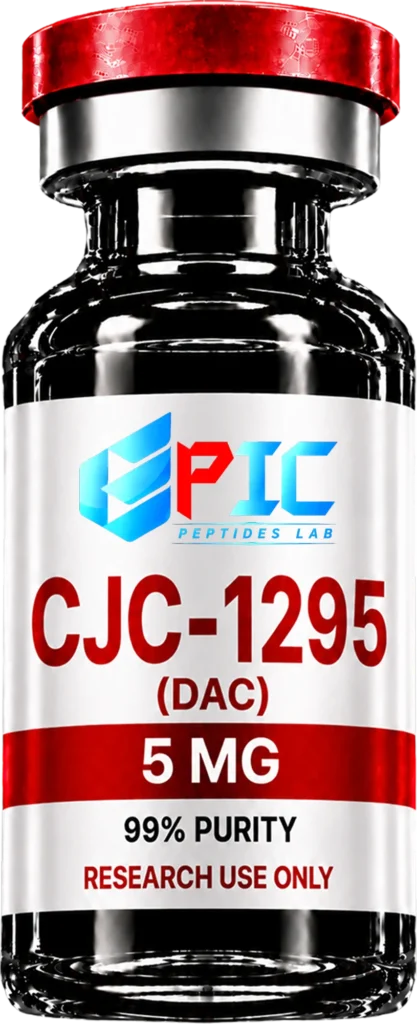
Buy CJC-1295 DAC 5MG peptide – long-acting growth hormone releasing hormone analog with Drug Affinity Complex. Provides sustained GH elevation for up to 2 weeks. 99% purity, USA-made, Same Day Shipping.
Epic Peptides Lab · Research Use Only
Albumin-binding GHRH analog · 30 residues · CAS 863288-34-0
CJC 1295 DAC is a lyophilized 30-residue growth hormone-releasing hormone analog, CAS 863288-34-0, molecular formula C165H269N47O46, molecular weight 3647.2. A maleimidopropionyl group on the thirtieth residue forms a covalent bond with serum albumin, which is the modification the Drug Affinity Complex designation refers to.
| Property | Value |
|---|---|
| Compound | CJC-1295 with Drug Affinity Complex |
| CAS number | 863288-34-0 |
| Molecular formula | C165H269N47O46 |
| Molecular weight | 3647.2 g/mol |
| Residue count | 30 |
| Full modification nomenclature | Nε30-maleimidopropionyl-[D-Ala2, Gln8, Ala15, Leu27]-Sermorelin-Lys30 |
| Backbone | Tetrasubstituted human GHRH (1-29), extended by a thirtieth lysine |
| Substitution positions | 2, 8, 15 and 27 |
| Albumin-binding group | 3-maleimidopropionic acid on the Lys30 side-chain amine |
| Albumin conjugation site | Cysteine-34 of serum albumin, via thiol-maleimide addition |
| Bond type to albumin | Covalent, not reversible under physiological conditions |
| Molecular target | GHRH receptor (GHRHR), a class B G-protein-coupled receptor |
| Reported half-life | Several days, in contrast to roughly 30 minutes for the no-DAC form |
| Comparison, no-DAC form | 29 residues, approximately 3367.9 g/mol, no albumin-binding group |
| Vial content | 5 mg lyophilized powder |
| Molar content of vial | Approximately 1.37 µmol |
| Appearance | White lyophilized cake |
| Purity | Per lot-specific certificate of analysis |
| Solubility | Soluble in bacteriostatic and sterile water |
| Storage, lyophilized | -20°C, protected from light and moisture |
| Storage, reconstituted | 2-8°C, protected from light |
| Maleimide reactivity caution | Reacts with free thiols. Avoid reducing agents and thiol-containing buffers |
| Regulatory status | No approved human or veterinary formulation in any jurisdiction |
For CJC 1295 DAC the name is vague and the chemistry precise, so it is worth setting the chemistry out properly.
The full modification nomenclature is Nε30-maleimidopropionyl-[D-Ala2, Gln8, Ala15, Leu27]-Sermorelin-Lys30. Read from the inside out, that describes a GHRH (1-29) backbone carrying four amino acid substitutions at positions 2, 8, 15 and 27, extended by a thirtieth residue, lysine, whose side-chain amine bears 3-maleimidopropionic acid.
The maleimide is the functional part. Maleimides react rapidly and selectively with free thiol groups through Michael addition, forming a stable thioether bond. Human serum albumin carries exactly one free cysteine, Cys34, and it is the most abundant free thiol in plasma.
The consequence is that after entering circulation the peptide finds albumin and bonds to it covalently. Not reversibly, as with the fatty-acid acylation used by semaglutide and cagrilintide, but through a permanent chemical bond.
Albumin has a circulating half-life measured in weeks. A peptide covalently attached to it inherits protection from renal filtration and from most enzymatic degradation, which is where the multi-day half-life comes from.
CJC 1295 DAC differs by one structural feature that changes everything downstream. The two compounds are frequently discussed as variants of one product, which understates how different their pharmacology is.
Modified GRF (1-29) is 29 residues at approximately 3367.9 daltons with no albumin-binding group. It circulates free, clears on the timescale of a small peptide, and produces a discrete stimulation window of roughly 30 minutes.
CJC-1295 DAC is 30 residues at 3647.2 daltons carrying the maleimide. It bonds to albumin and persists for days.
Both act at the same receptor through the same signalling route. The difference is entirely exposure duration, and that difference determines which research questions each can address. A pulse-timing study needs the short-acting form. A sustained-raising study needs this one. Neither substitutes for the other.
A registry-number caution. CAS 863288-34-0 belongs to this DAC-bearing molecule, and its formula and mass confirm that. The number is nonetheless quoted widely on listings for the no-DAC form, which is a different substance. Where a certificate pairs this CAS with a mass near 3367.9, the two do not describe the same thing and the mass is the more reliable figure.
This compound has genuine human data behind it, which distinguishes it from the no-DAC form and from most of this catalogue.
Teichman and colleagues published a single ascending-amount study in human subjects, reporting pharmacokinetics, pharmacodynamics and tolerability alongside growth hormone and IGF-1 measurements (Teichman et al., Journal of Clinical Endocrinology and Metabolism, 2006). Sustained IGF-1 raising following exposure is the central finding, and it supports the albumin-binding rationale directly.
Ionescu and Frohman addressed a question the sustained-exposure design raises naturally: whether continuous GHRH receptor stimulation abolishes the pulsatile character of growth hormone secretion (Ionescu and Frohman, Journal of Clinical Endocrinology and Metabolism, 2006). They reported that pulsatility persisted despite continuous stimulation, which is a mechanistically interesting finding and relevant to any study assuming a long-acting analog flattens the secretory profile.
Alba and colleagues characterised the molecule in GHRH-knockout mice, providing the animal counterpart (Alba et al., American Journal of Physiology: Endocrinology and Metabolism, 2006).
Reported adverse observations across the early studies were predominantly injection-site reactions, flushing, headache and mild fluid retention. Study sizes were small and durations short, so long-term safety is not characterised.
The reactive group that makes this compound work also makes it more demanding to handle than a conventional peptide, and this is rarely mentioned.
Maleimides react with free thiols. That is the intended reaction with albumin Cys34, and it is equally an unintended reaction with any other thiol the compound encounters. Reducing agents such as dithiothreitol or beta-mercaptoethanol will consume the maleimide before it reaches its target. Thiol-containing buffers do the same.
Cell culture media are worth checking. Some formulations contain cysteine or glutathione, both of which present free thiols. Where a design adds this compound to a thiol-containing medium, a proportion will be consumed before reaching any receptor, and the effective concentration will be lower than calculated.
Maleimides also hydrolyse over time in aqueous solution, more rapidly at alkaline pH, and the hydrolysed ring no longer reacts with thiols. That gives reconstituted material a functional shelf life shorter than the peptide backbone alone would suggest.
Prepare fresh where the design permits, avoid alkaline buffers, and keep reconstituted solution cold and used promptly rather than stored at length.
Two half-life extension strategies appear across this catalogue, and they are frequently described interchangeably despite working quite differently.
Semaglutide and cagrilintide use fatty-acid acylation. A lipid chain attached to the peptide promotes reversible association with albumin through hydrophobic interaction. The peptide is in equilibrium between bound and free states, and only the free fraction is available to engage receptors at any moment.
CJC-1295 DAC uses covalent conjugation. The maleimide forms a permanent thioether bond with albumin Cys34, and there is no equilibrium. The peptide remains attached for the lifetime of that albumin molecule.
The pharmacological consequences differ. Reversible binding creates a depot that releases free peptide continuously, so receptor-available concentration is buffered and relatively steady. Covalent attachment raises a different question: whether the albumin-peptide conjugate can engage the receptor at all while still attached, or whether activity requires the albumin to be degraded first.
That question is not fully resolved in the published literature, and it matters for interpreting exposure-response relationships. A compound whose active species is a large protein conjugate behaves differently from a small peptide in equilibrium with a carrier.
Maleimide integrity is the property that distinguishes a functional preparation from a peptide that merely has the right mass, and it is not routinely reported.
The functional group hydrolyses over time in aqueous conditions to an open-ring maleamic acid, which no longer reacts with thiols. Mass spectrometry detects it as a plus-eighteen dalton species, and the proportion relative to the intact peptide reports how much reactive material remains.
A thiol-reactivity assay is the direct functional test. Incubating a sample with a defined thiol and measuring consumption establishes what proportion of the preparation can still conjugate.
Neither test is standard on a certificate of analysis, and both are worth requesting for a compound whose entire pharmacological rationale depends on that one reactive group.
For lyophilized material stored correctly the concern is modest. For reconstituted solution held for an extended period it is the first thing to question when activity appears lower than expected.
Five milligrams is approximately 1.37 micromoles. Reconstituted into 1 ml that gives roughly a 1.37 mM stock.
Introduce diluent slowly against the vial wall and swirl until clear rather than shaking. Bacteriostatic water is common for multi-draw preparations, though the benzyl alcohol it contains is worth noting where a downstream cell assay may be sensitive to it.
Store the lyophilized cake at -20°C, sealed and shielded from light and moisture. Reconstituted solution at 2-8°C protected from light, and use it promptly given maleimide hydrolysis rather than storing for extended periods.
Record lot number, diluent identity, volume, concentration, preparation date and, unusually for a peptide, the interval before use. For a compound whose functional group degrades independently of its backbone, elapsed time in solution is a variable that affects what the preparation can still do.
Cross-checked against publisher records or primary indexes. Unlike the no-DAC form, this compound has genuine human clinical data behind it.
A lyophilized 30-residue growth hormone-releasing hormone analog, CAS 863288-34-0, molecular weight 3647.2, carrying a maleimidopropionyl group that bonds covalently to serum albumin. Supplied at 5mg for laboratory research use only and not approved for human or veterinary use.
A 3-maleimidopropionic acid group attached to the side-chain amine of a thirtieth lysine residue. Maleimides react selectively with free thiols, and human serum albumin carries exactly one, Cys34. The peptide bonds to albumin covalently after entering circulation.
No. Thiol-maleimide addition forms a stable thioether bond, unlike the reversible fatty-acid acylation used by semaglutide and cagrilintide. Albumin has a circulating half-life measured in weeks, and a covalently attached peptide inherits that protection from clearance and degradation.
By one structural feature with large consequences. The no-DAC form is 29 residues at roughly 3367.9 daltons with no albumin-binding group, clearing in around 30 minutes. This form is 30 residues at 3647.2 carrying the maleimide, and persists for days.
CAS 863288-34-0 belongs to this DAC-bearing molecule, and its formula and mass confirm it. The same number is quoted widely on listings for the no-DAC form, which is a different substance. Where a certificate pairs this CAS with a mass near 3367.9, trust the mass.
A single ascending-amount study in human subjects reported pharmacokinetics, pharmacodynamics and tolerability alongside growth hormone and IGF-1 measurements, with sustained IGF-1 raising as the central finding. A separate study examined whether pulsatility persists under continuous stimulation.
Published work reports it does not. Pulsatility persisted despite continuous GHRH receptor stimulation, which is mechanistically interesting and relevant to any study assuming that a long-acting analog necessarily flattens the secretory profile. That assumption is not supported.
It reacts with any free thiol, not only albumin. Reducing agents such as dithiothreitol or beta-mercaptoethanol consume it before it reaches its target, as do thiol-containing buffers. Some cell culture media contain cysteine or glutathione, which present the same problem.
Yes. Maleimides hydrolyse over time in aqueous conditions, faster at alkaline pH, and the hydrolysed ring no longer reacts with thiols. That gives reconstituted material a functional shelf life shorter than the peptide backbone alone would suggest, so prepare fresh where possible.
The usual lot, diluent, volume, concentration and date, plus the interval before use. For a compound whose functional group degrades independently of its backbone, elapsed time in solution determines what the preparation can still do and belongs in the experimental record.
Fatty-acid acylation promotes reversible albumin association through hydrophobic interaction, leaving the peptide in equilibrium between bound and free states. The maleimide forms a permanent thioether bond with albumin Cys34, so there is no equilibrium and no free fraction.
It raises a question reversible binding does not. Whether the albumin-peptide conjugate can engage the receptor while still attached, or whether activity requires albumin degradation first, is not fully resolved in the literature and matters for interpreting exposure-response relationships.
Semaglutide and cagrilintide both use fatty-acid acylation, creating a depot that releases free peptide continuously so receptor-available concentration stays buffered and relatively steady. CJC-1295 DAC is the only covalent example across the three tranches.
CJC-1295 DAC 5mg is sold exclusively for laboratory research use. It is not a drug, food, or cosmetic product, and it is not a dietary product of any kind. It is not approved by the FDA or any comparable authority for human or veterinary use, and growth hormone secretagogues are prohibited in competitive sport under World Anti-Doping Agency rules. This product is not intended to diagnose, treat, cure, or prevent any disease. It must not be given to humans or animals. Purchase is restricted to qualified researchers and institutions operating within applicable laws. All handling is the responsibility of the purchasing laboratory.
| Weight | 0.5 lbs |
|---|---|
| Dimensions | 3 × 3 × 4 in |
| Package | Vial, Kit (10 Vials) |
The same verification the labs that use our compounds demand — documented, transparent, and enforced on every order.

Independent HPLC and mass-spec testing confirms identity and purity on every batch.

A full certificate of analysis is published and downloadable for every lot we ship.

Tracked, discreet packaging with reshipment coverage on qualifying orders.

Orders confirmed before 12 PM PT on business days ship the same day from our US-based facility.
Enter your details to access our catalog, COA library,
and research compound database.
By submitting you agree to receive email communications from Epic Peptides Lab You can unsubscribe at any time. All products for in vitro research use only.

Restock alerts, new compounds and fresh lab results.
We’ll email your code straight away – 15% off, one-time use.
Research updates only. Unsubscribe any time.
Reviews
There are no reviews yet.