
$139.99
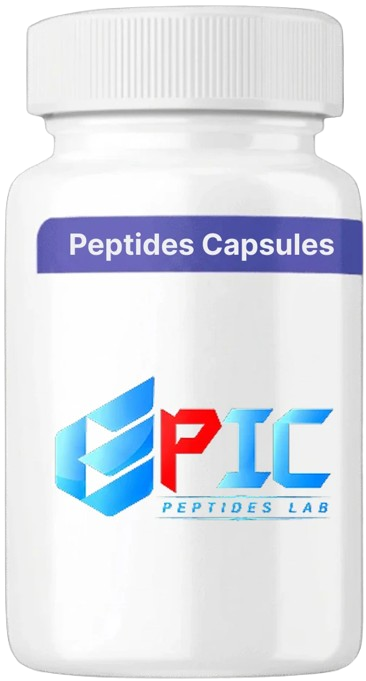
Peptides are not normally supplied as capsules because the gut destroys them. BPC-157 is the exception with an actual reason behind it: the sequence comes from a protein found in gastric juice and is reported stable in it. Laboratory research use only.
Epic Peptides Lab · Research Use Only
The one sequence here with a documented reason for an oral format
Almost no peptide is sold as a capsule, and the reason is the same in every case. Peptidases in the gut cut them apart before anything can be absorbed. BPC 157 capsules exist because this particular sequence has a documented answer to that objection, and the answer is where it came from.
| Property | Value |
|---|---|
| Compound | BPC-157 |
| CAS number | 137525-51-0 |
| Sequence | Gly-Glu-Pro-Pro-Pro-Gly-Lys-Pro-Ala-Asp-Asp-Ala-Gly-Leu-Val |
| Single letter | GEPPPGKPADDAGLV |
| Residue count | Fifteen. A pentadecapeptide |
| Molecular weight | Approximately 1419 |
| Origin | A partial sequence of a cytoprotective protein identified in human gastric juice |
| Reported stability | Stable in human gastric juice, which is the basis of the oral format |
| Composition note | Five of fifteen residues are proline, which constrains the backbone heavily |
| Aromatic content | None. No tryptophan, tyrosine or phenylalanine anywhere in the sequence |
| Presentation | Sixty capsules, each declared at 500 micrograms |
| Total declared content | 30 milligrams across the container |
| Article class | A formulated solid article, not loose powder |
| Reconstitution | None. There is nothing to dissolve |
| Storage | Sealed, cool, dry and away from light. Do not refrigerate without desiccation |
The general rule is well founded. A peptide taken by mouth meets pepsin in the stomach and a battery of pancreatic and brush border peptidases beyond it, and a fifteen residue chain has many places to be cut.
That is why the rest of this catalogue is vials and sprays, and why BPC 157 capsules need an argument the others do not.
The argument for this one rests on where the sequence came from.
It is a partial sequence of a larger cytoprotective protein that was identified in human gastric juice, which is to say in an environment that destroys most peptides as a matter of routine.
The group that described it reported the fragment as stable in human gastric juice, and that claim has been repeated and built on across their subsequent work.
Sikiric and colleagues have published the bulk of the literature on this compound over three decades, and the gastric stability property is presented consistently across it as the distinguishing feature.
It is worth being precise about what that establishes and what it does not.
Stability in gastric juice is a statement about survival in one compartment. Absorption across the intestinal wall is a separate question, and systemic availability after an oral quantity is a third.
The oral format is a reasonable inference from the stability property rather than a demonstrated equivalence to an injected one, and the published record supports the first much more thoroughly than the second.
There is a second reason the oral question is worth taking seriously here rather than dismissing it.
Most peptides sold as capsules are sold that way because the format is convenient, and the supplier is quiet about absorption.
This sequence at least has a published property behind the claim, which puts it in a different category from the general case even if it does not settle the question.
A researcher evaluating any oral peptide format should ask what the specific argument is, and should notice when there is not one.
Two features of GEPPPGKPADDAGLV shape everything analytical about this article.
The first is the proline run. Five of the fifteen residues are proline and three of them are consecutive, which locks large parts of the backbone into a restricted set of conformations.
The second is what is absent. There is no tryptophan, no tyrosine and no phenylalanine, which means the molecule has essentially no absorbance in the region where peptides are normally quantified.
Both of those are covered in more depth on the vial page, where they govern the chromatography and the ultraviolet quantification problem directly.
On a capsule they matter for a different reason.
Verifying the contents of BPC 157 capsules requires an assay method, and a compound that cannot be quantified by ordinary ultraviolet detection needs one built deliberately.
A supplier reporting an assay per unit for this compound should be able to say what method produced the number, because the obvious method does not work here.
That question is worth asking on any capsule and it is worth asking twice on this one.
A vial of powder is one substance. BPC 157 capsules are a shell around a blend.
At 500 micrograms of active per unit, the compound is a small minority of the fill mass and the rest is excipient chosen to make sixty units fill consistently.
The compendial question therefore shifts from purity to uniformity. Purity asks what fraction of a material is the intended compound. Uniformity asks whether the units resemble one another.
Those two can fail independently, and a blend can be entirely pure and still fill unevenly.
Segregation of a powder mixture by particle size or density during handling is the standard route to that failure, and it has been reviewed at length in the manufacturing literature.
The excipients also come along into whatever the capsule is used for. They are part of the article rather than packaging for it.
None of this is a criticism of the format. It is a description of what the format is, and the reason it matters is that a certificate written for a vial does not answer any of it.
One consequence of the format deserves stating separately, because it is easy to miss.
A capsule cannot be inspected.
A vial of lyophilized powder shows its cake, and a collapsed or discoloured cake tells a researcher something before any instrument is involved.
Sixty opaque shells show nothing at all, and the only information available about the contents is whatever the certificate says.
That shifts more weight onto the paperwork than most formats do, which is a reason to read it more carefully rather than less.
For BPC 157 capsules, identity of the compound by mass spectrometry, run on the fill rather than on an intact unit.
Purity of the compound before encapsulation, by chromatography, with the method named.
Assay per unit, meaning the quantity actually found in a capsule rather than the quantity intended.
The method behind that assay figure, which on this sequence cannot be routine ultraviolet detection.
Uniformity across units, which requires more than one capsule to have been tested and the spread reported.
A full excipient declaration.
Confirmation of the full fifteen residue sequence rather than a trade name, since truncated synthesis products are the realistic impurity here.
Lot number, manufacturing date and the storage condition the figures apply to.
A document reporting a single purity percentage has described a powder that no longer exists in that form, and has said nothing about the sixty units in the container.
This is the section where a research page has to be careful, and being careful here is easier than it looks.
The literature on this compound is large, it is dominated by one research group, and it is almost entirely animal work.
The models are varied and the reported findings across them are consistent within that body of work.
What is thin is independent replication outside the originating group, and what is largely absent is controlled human data.
A researcher reading the field will find a great many papers and should notice how few author lists are involved in producing them.
That is a normal situation for a compound that never entered a conventional development programme, and it is a reason to weight the evidence carefully rather than a reason to dismiss it.
The specific claim this page rests on, stability in gastric juice, is a physical chemistry observation rather than a biological outcome, and it is the kind of claim that is easiest to verify independently.
Anyone building work on the oral format should look for that verification specifically, because it is the load-bearing part of the argument.
Solid oral formats fail in ways that vials do not, and none of the freeze-thaw and adsorption rules from the rest of this catalogue apply.
Store BPC 157 capsules sealed, cool, dry and out of light.
The closure is doing real work. Capsule shells take up moisture, and a shell that has absorbed water becomes tacky and can distort or stick.
Refrigeration without desiccation is the common mistake. Moving a container between a cold shelf and a warm room drives condensation onto the shells, which is worse than a stable room temperature.
Do not decant into a secondary container unless the closure and any desiccant travel with it.
Do not open capsules to weigh the fill. The active is a small fraction of the mass and a weighed portion of blend is not a weighed portion of compound.
Where an aqueous solution is needed, the material to dissolve is characterised powder from a vial rather than capsule contents.
Record lot, the assay per unit as stated, the method behind it, the count at receipt, storage temperature and the date the container was first opened.
The open date carries more weight on a moisture sensitive format than it does elsewhere, because a container of sixty units is opened repeatedly across the life of a study rather than once.
A closing note on comparing this format against the vial, since a laboratory holding both will want to.
They are not interchangeable inputs to the same experiment.
A vial supports a known concentration in a known solvent. A capsule supports a declared quantity in a formulation whose behaviour in any given system is a separate question.
Work designed around one should not be reported as though it had used the other, and the two should be recorded distinctly even where the compound is nominally the same.
Selected references on the compound and its reported gastric stability, on content uniformity in solid manufactured articles and on peptide storage generally.
Why are peptides not usually sold as capsules?
Because pepsin in the stomach and pancreatic and brush border peptidases beyond it cut a peptide chain apart before absorption, which is why BPC 157 capsules are unusual. A fifteen residue sequence offers many places to be cut.
What makes this sequence different?
It is a partial sequence of a cytoprotective protein identified in human gastric juice, and the originating group reports it as stable in that environment.
Does stability in gastric juice mean it is absorbed?
No. Survival in one compartment, absorption across the intestinal wall and systemic availability are three separate questions. The published record supports the first far more thoroughly.
What is the sequence?
GEPPPGKPADDAGLV, fifteen residues, calculating to approximately 1419 daltons and carrying CAS 137525-51-0.
Why does the proline content matter?
Five of fifteen residues are proline and three are consecutive, which locks much of the backbone into restricted conformations and complicates the chromatography.
Why is ultraviolet quantification a problem?
The sequence contains no tryptophan, tyrosine or phenylalanine, so it has essentially no absorbance where peptides are normally quantified. Any assay figure needs a stated method.
What changes when it is a capsule?
A capsule is a shell around a blend, and at 500 micrograms per unit the compound is a small minority of the fill. The question becomes uniformity between units rather than purity of a powder.
Can uniformity fail in a pure blend?
Yes. Segregation by particle size or density during handling and filling is the standard route, and it is entirely independent of how pure the material is.
How many capsules are in the container?
Sixty units at a declared 500 micrograms each, which is thirty milligrams of declared compound across the container.
What should the assay figure state?
The quantity found per unit rather than intended, the spread across units, and the method used. On this sequence the obvious ultraviolet method does not work.
What does the published literature cover?
A large body of mostly animal work dominated by one research group, with thin independent replication and little controlled human data. The gastric stability claim is the most independently checkable part.
How should the container be stored?
Sealed, cool, dry and away from light. Capsule shells are moisture sensitive, and refrigeration without desiccation drives condensation onto them.
BPC-157 is sold exclusively for laboratory research use. It is not a drug, food, or cosmetic product, and it is not a dietary product of any kind. It is not approved by the FDA or any comparable authority for human or veterinary use, it is supplied here as a formulated solid article rather than as a characterised powder and the handling conventions used elsewhere in this catalogue do not apply to it, its published record is dominated by a single research group working almost entirely in animal models with limited independent replication, stability in gastric juice is a physical observation and is not evidence of absorption or of systemic availability, and no compound in this range is offered for any human or veterinary purpose. This product is not intended to diagnose, treat, cure, or prevent any disease. It must not be given to humans or animals. Purchase is restricted to qualified researchers and institutions operating within applicable laws. All handling is the
| Weight | 3 lbs |
|---|---|
| Dimensions | 6 × 6 × 8 in |
The same verification the labs that use our compounds demand — documented, transparent, and enforced on every order.

Independent HPLC and mass-spec testing confirms identity and purity on every batch.

A full certificate of analysis is published and downloadable for every lot we ship.

Tracked, discreet packaging with reshipment coverage on qualifying orders.

Orders confirmed before 12 PM PT on business days ship the same day from our US-based facility.
Enter your details to access our catalog, COA library,
and research compound database.
By submitting you agree to receive email communications from Epic Peptides Lab You can unsubscribe at any time. All products for in vitro research use only.

Restock alerts, new compounds and fresh lab results.
We’ll email your code straight away – 15% off, one-time use.
Research updates only. Unsubscribe any time.
Reviews
There are no reviews yet.