
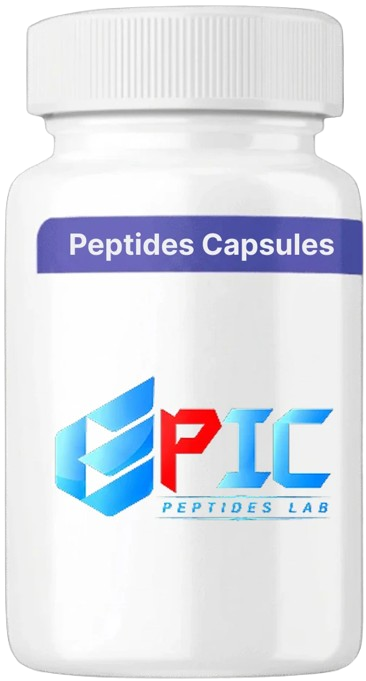
$189.99
The vial page explains that a declared 50mg of this compound is the iodide salt, and roughly forty-four percent of that mass is iodide. Putting that question inside a capsule, where the active is a minority of the fill, makes it harder rather than easier to answer.
Epic Peptides Lab · Research Use Only
A salt fraction you cannot resolve, inside a blend you cannot inspect
5-amino-1mq capsules carry two separate uncertainties that sit inside each other. The first is which mass the label refers to, which the vial page in this catalogue works through. The second is that a capsule is a blend and a blend cannot be inspected, so the first question becomes harder to settle rather than easier.
| Property | Value |
|---|---|
| Compound | 5-Amino-1-methylquinolinium |
| Common designation | 5-Amino-1MQ |
| Article class | A small molecule. Not a peptide |
| Charge | Permanently cationic. A quaternary nitrogen with no lone pair |
| Cation mass | Approximately 159.2 |
| Iodide salt mass | Approximately 286.1 |
| Cation share of the salt mass | Around fifty-six percent |
| Declared content per unit | 50 milligrams |
| What that 50mg refers to | Salt or cation. The certificate has to say which |
| Cation quantity if the label means salt | Around 28 milligrams per unit |
| Molar quantity per unit | Around 175 micromoles either way |
| Container | Sixty capsules |
| Total declared content | 3 grams across the container |
| Article type | A formulated solid. The fill is a blend and the active is a minority of it |
| Storage | Sealed, cool, dry and away from light. Keep the desiccant |
The certificate for 5-amino-1mq capsules has to say, and most do not.
This compound is a permanently charged cation and it cannot exist on its own. It arrives paired with a counterion, usually iodide.
The cation has a mass around 159.2 and the iodide salt around 286.1, so iodide accounts for roughly forty-four percent of the salt mass.
A declared 50 milligrams is therefore either 50 milligrams of salt, which is about 28 milligrams of cation, or 50 milligrams of cation, which is about 90 milligrams of salt.
Those are different articles and the difference is close to a factor of two.
The vial page in this catalogue covers this properly and it is the place to go for the full argument.
What is specific to the capsule is that the ambiguity becomes harder to resolve.
On a vial you can weigh the contents and analyse them. On a capsule the fill is a blend containing excipient, and the active is a minority of the mass, so weighing tells you nothing and a determination on the fill needs a method built for the job.
One helpful thing about the molar figure: 175 micromoles is 175 micromoles whether the label meant salt or cation, because a mole of salt contains a mole of cation. If a certificate states molar content, the ambiguity disappears. Almost none of them do.
Compared with the thirty-capsule format elsewhere in this catalogue, a container of sixty 5-amino-1mq capsules is mostly open for longer.
A container of sixty units is entered sixty times, or close to it.
Every entry admits room air, and this is a hygroscopic article in a moisture-sensitive shell.
Capsule shells take up water, become tacky and can distort or stick together, and a container that has been opened sixty times over six months has seen considerably more humid air than one opened thirty times over three.
That is a slow failure and it shows as caking or as shells that no longer separate cleanly, rather than as anything chemical.
The second consequence is about uniformity.
Content uniformity is a property of the filling run, and a larger container means more units drawn from the same blend, which is neutral in itself.
It stops being neutral if the blend segregated during filling, because a segregated blend fills unevenly along the run and a sixty-unit container samples more of that run than a thirty-unit one.
That could make the variation more visible or less, depending on where in the run the container was filled, and nobody outside the manufacturer knows.
On 5-amino-1mq capsules, the salt form named explicitly, and whether the declared mass refers to the salt or the free cation.
Ideally the molar content per unit, which removes the ambiguity entirely and which nobody supplies.
Identity of the active by nuclear magnetic resonance or mass spectrometry, run on the fill rather than on an intact unit.
Assay per unit, meaning the quantity found rather than intended, with the method named on the document.
Uniformity across units, which requires more than one capsule to have been tested and the spread reported.
A full excipient declaration, since those materials enter whatever the capsules are used for.
Water content. The article is hygroscopic and the container is opened repeatedly.
Lot number, manufacturing date and the storage condition the figures apply to.
The salt line and the assay line together do the work. Either one alone leaves you knowing half of what you need to calculate a quantity.
The vial beats 5-amino-1mq capsules for anything quantitative, and I would say so plainly rather than hedging it.
A vial of powder can be weighed, dissolved and analysed. The salt question can be settled by mass spectrometry on the material itself, and once settled the arithmetic is exact.
A capsule cannot be inspected. Its fill is a blend, and every quantity figure depends on a determination somebody else ran.
What the capsule format buys is an oral presentation, and that is a genuine thing to want if the question involves the oral route.
If the question does not involve the oral route, the capsule is a worse version of the vial for research purposes.
That is a stronger statement than most product pages make about their own article.
The catalogue sells both, and choosing between them should turn on whether the route is the variable under study rather than on convenience.
One argument, applied to three different compounds. Setting it out properly here, because this is now the third capsule page in the catalogue and the argument has earned a full statement.
A capsule is a shell around a blend. The active is a minority of the fill mass, the fill cannot be inspected, and a certificate written to a vial template answers none of the questions the format raises.
What each of the three adds is a compound-specific complication on top of that.
SLU-PP-332 is a small molecule with a defined geometry at a double bond, and the certificate has to confirm which geometry is present.
BPC-157 has no aromatic residue, so the obvious assay method does not work and any quantity figure needs a stated alternative.
This one has a counterion carrying nearly half the declared mass.
The pattern across all three is that the capsule format removes the ability to check, and each compound has something specific that most needed checking.
That is not an argument against capsules. It is an argument for reading the certificate rather than the label, and for asking for the fields a vial certificate would never need.
The compound in 5-amino-1mq capsules is reported as an inhibitor of nicotinamide N-methyltransferase, and the vial page covers the target properly.
The short version is that the enzyme methylates nicotinamide, and inhibiting it has been studied as a way of altering how much nicotinamide is available for other routes.
Neelakantan and colleagues reported the inhibitor characterisation, and Kannt and colleagues published on the enzyme in metabolic contexts.
What the capsule format adds to that discussion is nothing, which is the point of a fill page.
The reason to mention it here at all is that a reader arriving on a capsule listing should be able to find the pharmacology in one click rather than being told a compressed version of it.
The compressed versions are where errors get introduced, and a page that summarises a target in three sentences is more likely to misstate it than a page that says where to go.
Short, and different from what usually arrives.
It would name the salt, state the molar content per capsule, and give an assay figure per unit with the method that produced it.
It would report the spread across a sample of units rather than a single number, since uniformity is the question a capsule raises and a single assay cannot answer it.
It would list every excipient by name and quantity.
It would carry a water content figure, because the article is hygroscopic and the container gets opened repeatedly.
Five fields. None of them is expensive to generate and none of them appears on a typical document for this article.
The reason to spell it out is that a supplier who is asked for specific fields will sometimes supply them, and a supplier who is asked for a better certificate will send the same one again.
Store 5-amino-1mq capsules sealed, cool, dry and out of light, with the desiccant left in.
Bring the container to room temperature before opening it. Cold plastic in a warm room collects water and the shells take it up.
Close it immediately after each entry. Sixty entries is sixty opportunities.
Do not decant into a secondary container unless the closure and the desiccant travel with it.
Do not open capsules to weigh the fill. The active is a minority of the mass and a weighed portion of blend is not a weighed portion of compound.
Where an aqueous solution is required, dissolve characterised powder from a vial rather than capsule contents.
Record lot, the salt form as stated, the assay per unit and its method, the count at receipt, storage temperature and the date the container was first opened.
First-open date matters more on a sixty-unit container than on a thirty, because the interval between that date and the last capsule used is longer and the moisture exposure is cumulative.
Selected references on the enzyme target, on content uniformity in solid manufactured articles and on the analytical chemistry of quaternary ammonium compounds.
What does the 50mg on the label refer to?
The certificate has to say. It is either 50 milligrams of the iodide salt, which is about 28 of cation, or 50 of cation, which is about 90 of salt.
How large is that difference?
Close to a factor of two. Iodide accounts for roughly forty-four percent of the salt mass, since the cation is about 159.2 and the salt about 286.1.
Is there a figure that removes the ambiguity?
Molar content per unit. A mole of salt contains a mole of cation, so 175 micromoles is 175 micromoles either way. Almost no certificate states it.
Why is the capsule harder than the vial here?
Because the fill is a blend and the active is a minority of the mass. Weighing tells you nothing and a determination on the fill needs a method built for it.
What does a sixty-unit container change?
Mostly how long it is open for. Sixty entries admit more room air than thirty, and this is a hygroscopic article in a moisture-sensitive shell.
How does moisture damage show?
As caking, or shells that become tacky and no longer separate cleanly. It is a slow physical failure, not a chemical one.
Does container size affect uniformity?
Only if the blend segregated during filling. A larger container samples more of the filling run, which could make variation more visible or less depending on where it was filled.
What two certificate fields matter most?
The salt form, and the assay per unit with its method. Either alone leaves you knowing half of what a quantity calculation needs.
Can the capsules be opened and weighed?
Not usefully. The active is a minority of the fill mass, so a weighed portion of blend is not a weighed portion of compound.
Is the capsule or the vial better for research?
The vial, for anything quantitative. It can be weighed, dissolved and analysed, and the salt question can be settled on the material itself.
When is the capsule the right article?
When the oral route is the variable under study. If the route is not the question, the capsule is a worse version of the vial for research purposes.
What belongs in the record?
Lot, salt form as stated, assay per unit and its method, count at receipt, storage temperature and the date the container was first opened.
5-Amino-1MQ is sold exclusively for laboratory research use. It is not a drug, food, or cosmetic product, and it is not a dietary product of any kind. It is not approved by the FDA or any comparable authority for human or veterinary use, it is a small molecule rather than a peptide and the handling conventions used elsewhere in this catalogue do not apply to it, the declared mass may refer to the salt or to the free cation and the difference is close to a factor of two so a quantity cannot be calculated without that field, it is supplied here as a formulated solid whose fill is a blend and whose active is a minority of the mass, and no compound in this range is offered for any human or veterinary purpose. This product is not intended to diagnose, treat, cure, or prevent any disease. It must not be given to humans or animals. Purchase is restricted to qualified researchers and institutions operating within applicable laws. All handling is the responsibility of the purchasing laboratory.
| Weight | 0.5 lbs |
|---|---|
| Dimensions | 3 × 3 × 4 in |
The same verification the labs that use our compounds demand — documented, transparent, and enforced on every order.

Independent HPLC and mass-spec testing confirms identity and purity on every batch.

A full certificate of analysis is published and downloadable for every lot we ship.

Tracked, discreet packaging with reshipment coverage on qualifying orders.

Orders confirmed before 12 PM PT on business days ship the same day from our US-based facility.
Enter your details to access our catalog, COA library,
and research compound database.
By submitting you agree to receive email communications from Epic Peptides Lab You can unsubscribe at any time. All products for in vitro research use only.

Restock alerts, new compounds and fresh lab results.
We’ll email your code straight away – 15% off, one-time use.
Research updates only. Unsubscribe any time.
Reviews
There are no reviews yet.